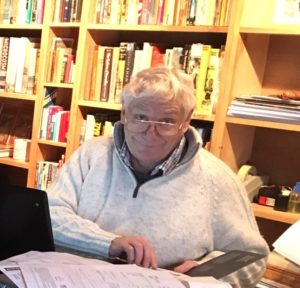
In 1962, armed with a degree in Physics and a Diploma in Applied Geophysics, I left the UK for Australia, where I worked for the national government’s Bureau of Mineral Resources as a geophysicist for six years before returning to London for a doctoral study of the gravity field of eastern Papua New Guinea. Since that time I have worked in hydrology, in the oil and mining industries, for governments directly and on aid programmes, in higher education and on conservation projects, but always as a geophysicist.
Much of my work has involved the application of measurements of gravity field to understanding geology, at all scales from cavities to continents. In 1981 I founded London University’s first undergraduate geophysics degree, which I taught until retirement in 2004. I then returned to consultancy; interesting projects concerned the search for unexploded World War 2 ordnance along the subsea route of the Nordstream 2 pipeline (now inoperable due to the explosion of much more recent ordnance) and on the extension, on geological grounds, of the Philippines continental shelf. My fieldwork has taken me to every continent except Antarctica but my main research interests and expertise have been focused on the island festoons of Southeast Asia and Melanesia, and for about ten years after retiring I retained a link with the academic world as an Honorary Professor in the Department of Earth Sciences at Hong Kong University.
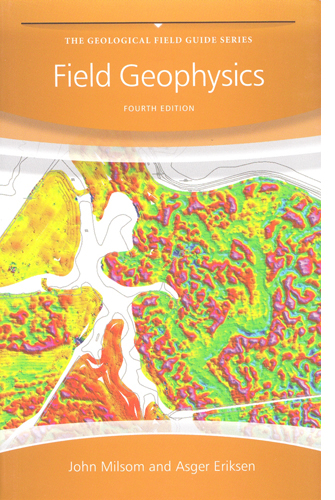
My first attempts at book writing resulted in a textbook on Field Geophysics, first published in 1989 and which over the years went through two revised editions before a fourth edition co-authored with Asger Eriksen was published in 2011. A fifth edition (for which I have done no more than look in wonder at the way its two authors, Asger and Brian Barrett, have dealt with the way the science has moved on) is due to be published early in 2027.
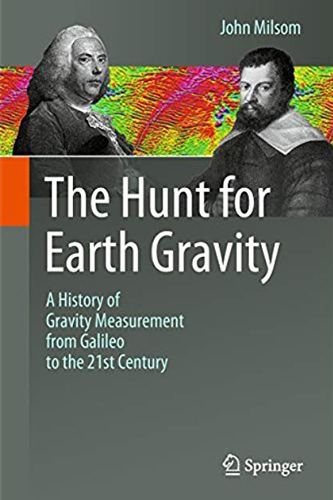
In 2014, following a major downturn that saw many geophysicists unemployed, I decided to write a history of the measurement of Earth gravity and that led me into a wider interest in the history of global scientific exploration and the stories of the people who took part, including the story of Rose de Freycinet, the second woman to ever circumnavigate the globe and the first to keep a full diary of her experiences. Many of the blogs on this site are concerned with her and her companions on the French corvette Uranie. One of those companions, the junior surgeon Joseph Paul Gaimard, also kept a diary, the first part of which (Toulon to Guam) I, with Sylvie Brassard of the University of Western Australia, translated, edited and annotated, to be published by the Hakluyt Society in 2025.
As a result of a life spent travelling, I speak several languages very badly and tend to get them mixed up. Born and brought up in London, I have returned to my family roots and now live in the Welsh borderland where I have been, amongst other things, one of the governors of a small primary school noted for taking the final-year (10-11 year old) pupils on geological walks. For ten years I was also treasurer of a small charity promoting the idea of a Trans-National Peace Park on the borders of Kosovo, Montenegro and Albania. Mostly now, I just sit and write, some papers on geophysics and some on exploration actually getting published, and, as a member of committee of the UK’s History of Geology Group, talking and writing about the history of geophysics. And, thanks to my wife, bookseller extraordinary Marijana Dworski, and her family archives, translating and writing about the tangled histories of Eastern Europe in general and Croatia in particular. This now almost all-encompassing project, together with a continuing dedication to the geology and geophysics of Eastern Indonesia’s Banda Arcs, led me to abandon my project, begun in 2019, of writing three blogs every month, one on geophysics, one on exploration and one so-called ‘philosophy’ of Ayn Rand (of which I am definitely not a fan). They can still be read by following the links on this site.
ABSTRACTS…
Journal of the Hakluyt Society, June 2025
A TANGLED WEB. THE SEARCH FOR LAPÉROUSE
The Great Circle, 46/ 2, 2024
WHY MANUS? LOUIS DE FREYCINET AND THE MAGNETIC EQUATOR
The Falklands Island Journal, 2024
CASTAWAYS IN THE FALKLANDS: An Eye-Witness Account of the Stranding of the Officers and Men of the French Corvette Uranie in Berkeley Sound
Jean René Quoy, annotated and translated by John Milsom
Books
A Scientific Voyage in the Southern Hemisphere and Around the World: Narrative Journal of Joseph-Paul Gaimard Commissioned Surgeon of the Marine Royale (Hakluyt Society Third Series, 44)
The Hunt for Earth Gravity: A History of Gravity Measurement from Galileo to the 21st Century
Field Geophysics: 4th Edition
The Blogs
Ayn Rand was stupid…
which really wouldn’t matter, except that we now have a Home Secretary who is said to read a chapter of one her books, the Fountainhead, at least twice a year for inspiration!
… more>>
Science (mostly history, and mostly gravity)
Chasing the history of the gravity method sometimes took me down side-tracks that did not quite fit the theme, and so never made it into ‘The Hunt’… more>>
The Uranie…
…and other voyages. Scraps and jottings about voyages of exploration under sail, usually in some way related to the voyage of the French corvette Uranie, 1817 – 1820…more>>
The Long Read
Sometimes there’s just a little more to say… more>>
abstracts…
Journal of the Hakluyt Society, June 2025
A TANGLED WEB. THE SEARCH FOR LAPÉROUSE
Abstract
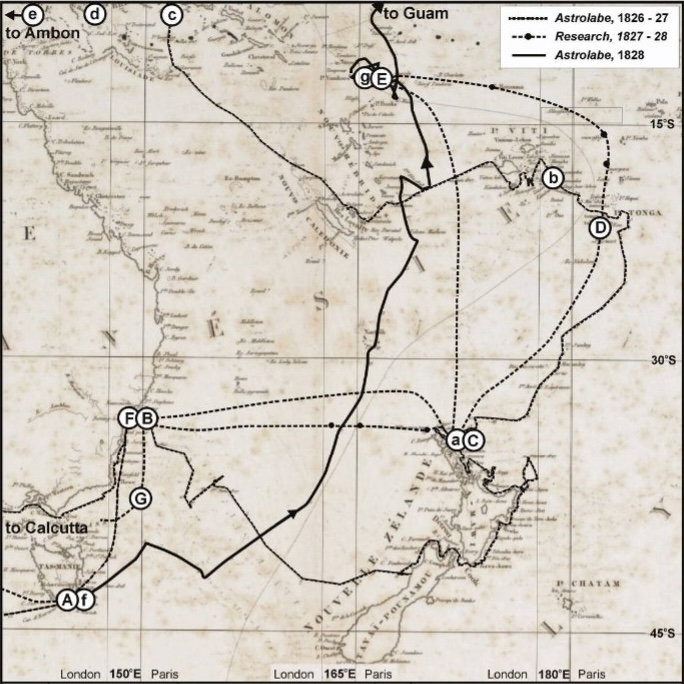
More than thirty years after the disappearance of the LaPérouse expedition, the search for survivors was reinvigorated by reports of objects of French naval origin being traded among islands in the SE Solomons. These clues to the fate of the expedition were followed up by two very different captains, one British, the other French, whose ships criss-crossed the area for more than a year without actually encountering each other. It was the British captain who reached the site of the shipwrecks first, but some of the reports sent back to Europe cast doubts on his priority, which even today is sometimes allocated to his French successor. [PDF full text. 26 pages. Bibliography. 1.4 MB]
The Great Circle, 46/ 2, 2024
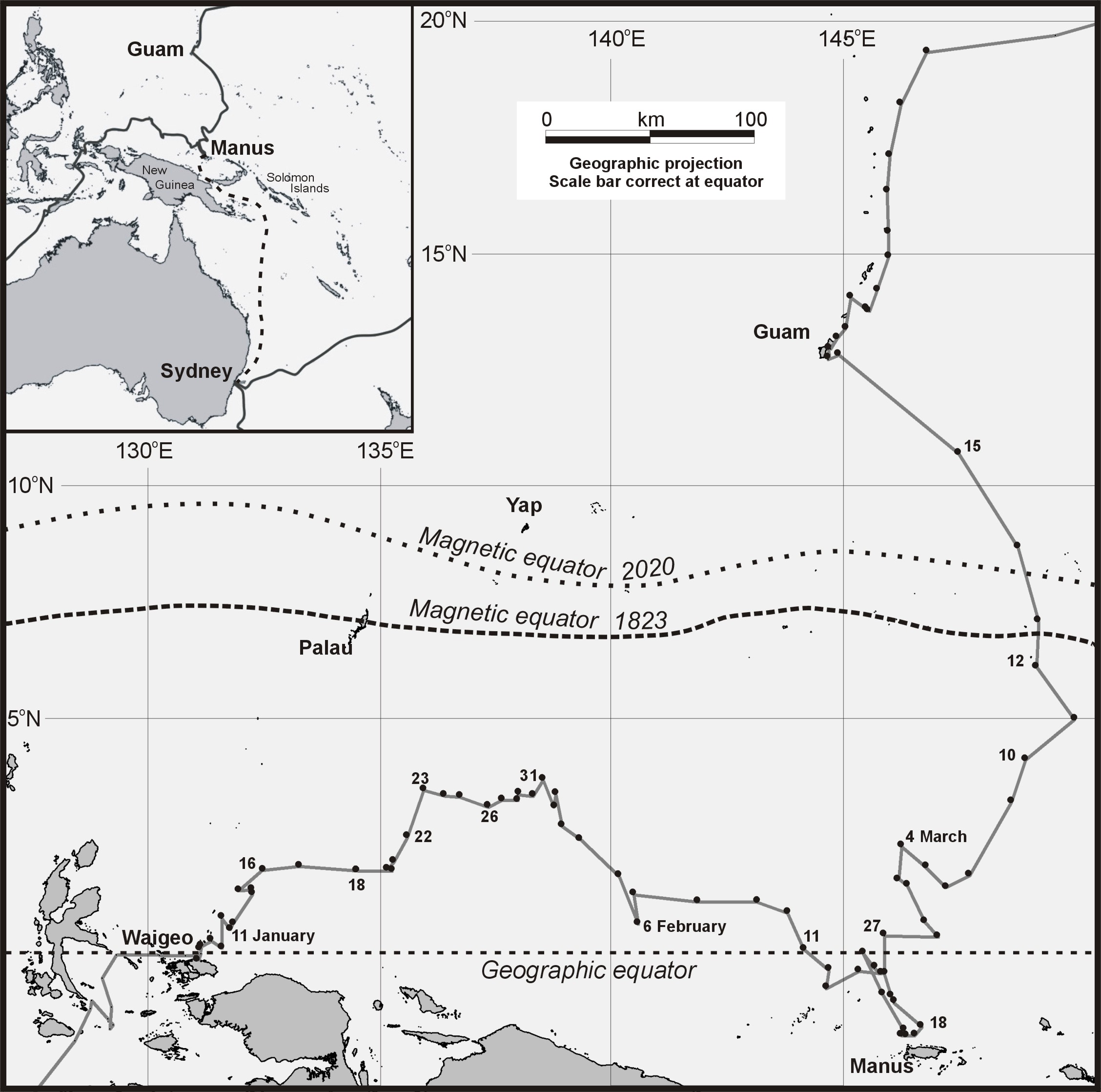
WHY MANUS? LOUIS DE FREYCINET AND THE MAGNETIC EQUATOR
Abstract
The Alpine orogeny is a consequence of the collision of Africa with Eurasia, which eliminated the Western Tethys Ocean. Processes similar to those that would have taken place early in that collision can today be seen operating in the islands of the Indo-Pacific gateway between Southeast Asia and Australia and have the potential to offer insights into the beginnings of orogenesis in the Alps. Studies of the gateway area emphasise the importance of the impact on subduction zones of topography on the downgoing plate, and of the effects of flows in the asthenosphere on lithosphere tectonics.
The Falklands Island Journal, 2024
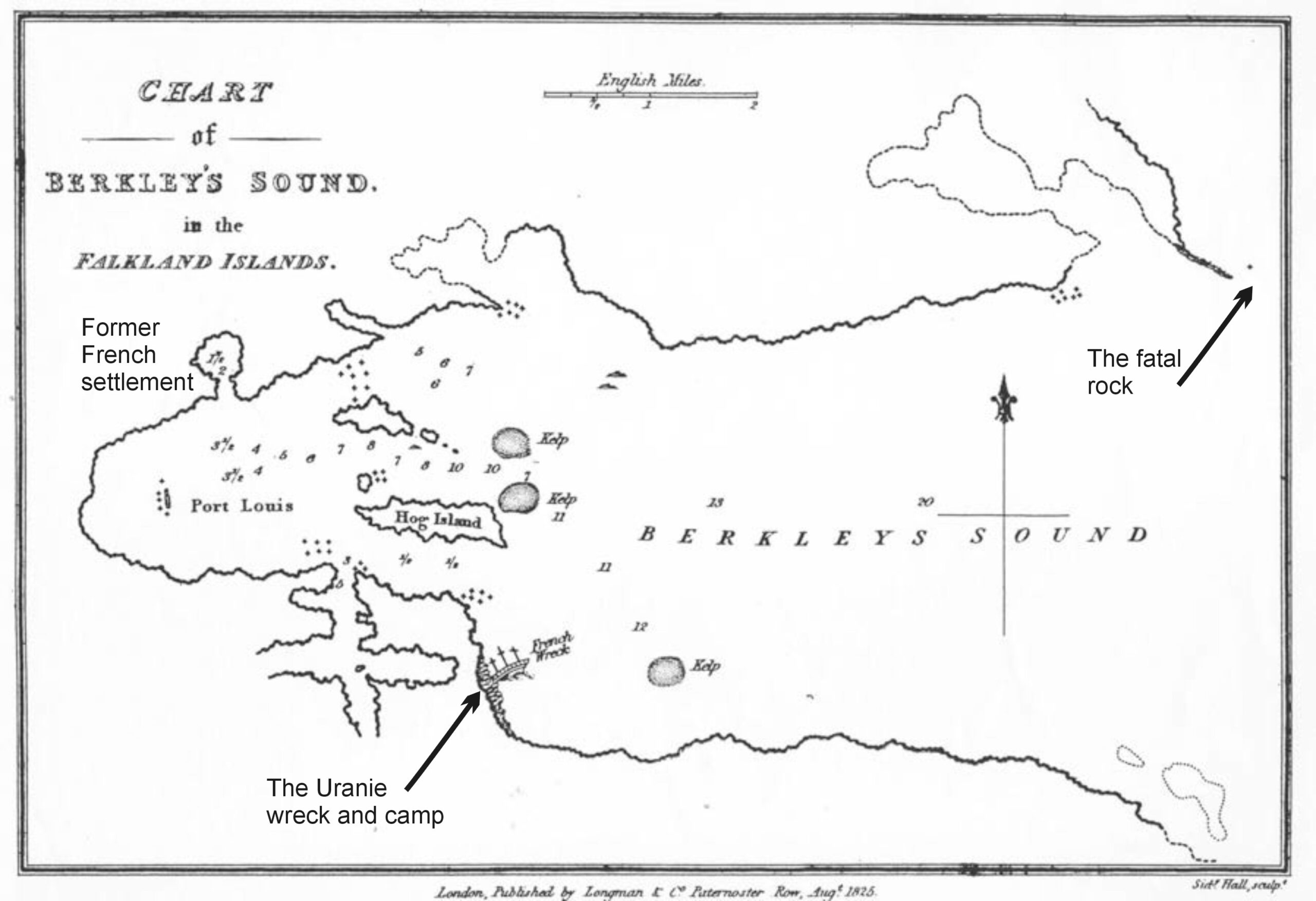
CASTAWAYS IN THE FALKLANDS: An Eye-Witness Account of the Stranding of the Officers and Men of the French Corvette Uranie in Berkeley Sound
Jean René Quoy, annotated and translated by John Milsom
Abstract
In September 2017 the French corvette L’Uranie left Toulon on what was planned to be a scientific circumnavigation of the globe, but on the 14th of February 1820, close to sinking after having been holed by a submerged rock at the entrance to Berkeley Sound, she was run aground in what was later christened Uranie Bay. Many of the ship’s stores and scientific collections were saved and no lives were lost; the list of castaways included not only the crew, the officers, the midshipmen, the chaplain and an artist, but also the captain’s wife, Rose, who had been smuggled on board by her husband the night before the ship left Toulon, and ten convicts, half of whom were Irish, who had smuggled themselves on board as the corvette was leaving Sydney Harbour. The accounts of the two and a half months written by Rose, by her husband and the artist have all survived, together with one other; the account by the senior surgeon, Jean René Quoy, which was published in an obscure French journal a few years after the return to France.
BOOKS by John Milsom